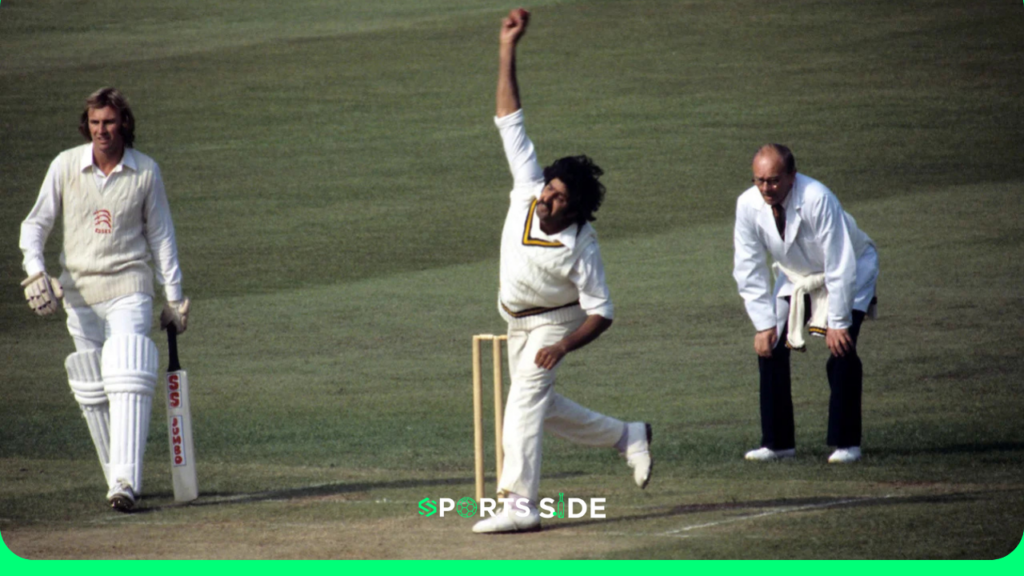
Dusty pitches and raging passion — the story of how Reverse Swing Bowling first emerged, courtesy of the maestro, Sarfaraz Nawaz. Born out of necessity, this spectacular style of bowling is a mixture of pace, deception and intelligence to adapt to the unforgiving and challenging conditions in South Asia.
The Dark Art: Reverse Swing Bowling
Pakistan have always been at the forefront of producing high-quality seamers. Whilst the conditions in Australia and England provided the utmost opportunity for bowlers to showcase their art, the underwhelming conditions in South Asia became a hurdle. Why? The answer is all in the basics. Dry and abrasive pitches allow the ball to lose its sheen after a mere couple of overs, making it softer and ideal for batters to hit fours and sixes — a frightening nightmare for bowlers, to say the least. In order to mitigate this issue and find a long-term solution, Sarfaraz Nawaz came up with a revolutionary technique — reverse swing bowling, which involves the concept of aerodynamics.
Since the ball is subject to wear and tear, Nawaz discovered that if one side of it retained its shiny surface, and the other became rough, the ball would behave in an unusual manner. Instead of swinging away from the shiny surface, the ball would swing towards it, outplaying the batters completely as it defied the conventional style. Playing it? Batters may disagree, but for the viewers, the pace and movement of the ball leave them in awe. It is simply a spectacle to watch. Now, the world has come to know of this secret, but the question that lies is if it still holds the importance it used to, due to the evolving nature of the game.
Read more about it: Death of reverse swing
The Sensational Spell Against the Aussies in 1979
Melbourne, 1979 — The day when the world came to know of Reverse Swing bowling. Sarfaraz Nawaz completely toppled Australia’s batting, leading Pakistan to a phenomenal victory in the Test match. From 305/3 to 310 all out. The stellar seven-wicket haul by Nawaz allowed Pakistan to clinch a historical win that once would have felt like an incoming one-sided disappointment. In fact, at one point, the Aussies were just 77 runs away from victory with Alan Border and Kim Hughes, who had already scored a great deal of runs, standing gallantly.
However, the aftermath of the match was not very pleasant. Accusations of ball-tampering, dishonesty and cheating followed Pakistan. Several cricket boards and even the public raised eyebrows at the rather unexpected swinging of the worn-out ball.
The Legacy and Succession of The Reverse Swing
Reverse Swing Bowling is, arguably, one of the best-kept secrets of all time by the Pakistani cricket team. Determined to keep this legacy alive, Imran Khan and Sarfaraz Nawaz played a pivotal role in this discourse. The WW duo comprising Wasim Akram and Waqar Younis completely redefined bowling in the cricketing world, all thanks to the mentorship of the great Imran Khan, the record-holding bowler. Their infamous and lethal reverse-swinging yorkers created immense fear in batters in the 1990s. Even the greatest batters like Sachin Tendulkar fell short and amplified the fear of reverse swing bowling. This duo perfected the dark art of cricket and set the stage for future bowlers who wanted to follow in their footsteps.
Reverse Swing Bowling is truly an art and will always remain the classic technique for the days to follow.
Read more about it: