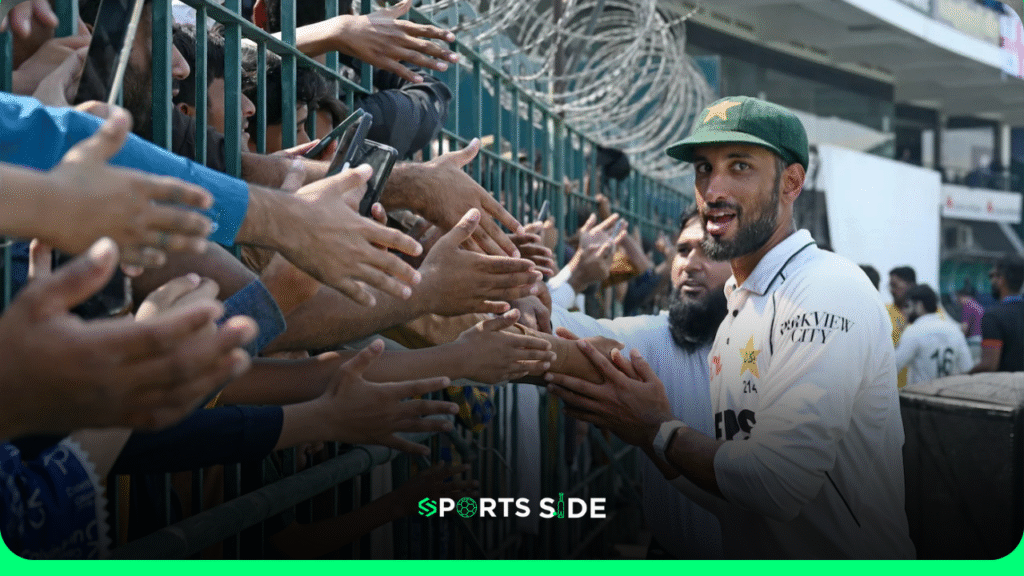
Pakistan captain Shan Masood was appointed as Consultant International Cricket and Players Affairs in a press release dated 24 October 2025, a move that has once again brought the debate on dual roles in PCB into the spotlight.
Such positions require international experience, strong communication skills, an understanding of player affairs, sound education, and familiarity with ICC regulations. Shan fulfills every one of these boxes. He attended Stamford School in Lincolnshire, England, where he completed his A Levels. He then studied Economics at Durham University, one of the United Kingdom’s most prestigious institutions, and pursued distance learning studies in Management and Sports Sciences at Loughborough University.
Shan’s credentials speak for themselves. Many coaches have praised his professionalism and communication skills. Former Pakistan bowling coach Jason Gillespie once said, “Really impressed by Shan’s communication with the players and how he’s gone about doing his job.”
However, Shan already holds one of the most demanding positions in Pakistan cricket, the Test captaincy. His record has been far from ideal. Since being appointed in November 2023, he has captained Pakistan in twelve Test matches, winning only three and losing nine. Pakistan also finished at the bottom of the World Test Championship 2025 standings. The facts are clear. Shan has not been able to deliver consistent success as captain, raising serious questions about whether it was wise to assign him another major responsibility.
The Consultant’s Seat: What Exactly Has Shan Been Tasked With?
As Consultant: International Cricket and Players Affairs, Shan will serve as a bridge between the players and the Pakistan Cricket Board. His responsibilities include advising the board on player contracts, welfare, and workload, representing player interests, providing input on tours, logistics, and fixtures, and offering feedback on regulatory and disciplinary issues.
It is an influential post that requires diplomacy, awareness, and a significant time commitment. The question is whether a full-time captain can dedicate the attention this role deserves.
History Repeats Itself: Dual Roles in PCB Are Nothing New
This is not the first time the Pakistan Cricket Board has experimented with overlapping or dual roles.
In 2019, when Misbah-ul-Haq was appointed both Head Coach and Chief Selector of the national team. The decision centralised immense authority in one individual. Within a year, Misbah resigned as selector, admitting that balancing both jobs was difficult. By September 2021, he stepped down as coach as well, realising how unsustainable the dual burden had become.
This pattern is hard to ignore. The PCB seems to return to the same governance formula, even after seeing its weaknesses exposed repeatedly.
Also Read :
Pakistan’s Endless Appetite for Multiple Roles
The concept of one person holding multiple powerful positions is not new in Pakistan. Whether in politics, business, or sports administration, multitasking at the highest levels has become a recurring trend.
When the Minister Becomes a Chairman
The current PCB Chairman, Mohsin Naqvi, serves as both the Chairman of the Pakistan Cricket Board and the Federal Minister for Interior. This rare overlap of political and administrative power has raised concerns about divided attention and focus.
Too Many Hats, Too Few Results
Despite the aura of authority, dual roles in PCB have rarely produced positive results. Since Mohsin Naqvi’s appointment, Pakistan’s performance on the international stage has steadily declined. Frequent changes in selectors, management teams, and leadership structures have led to instability and inconsistency. Critics believe one of the main causes is the burden of too many overlapping responsibilities.
Another Risky Experiment in Familiar Territory
The PCB has once again chosen to rely on individuals already carrying significant workloads. Shan Masood’s appointment mirrors this trend. Whether this experiment leads to genuine reform or becomes another chapter in Pakistan cricket’s governance challenges remains to be seen.
Conclusion: Lessons Yet to Be Learned
The story of dual roles in PCB is not one of innovation but repetition. History has shown that merging administrative and leadership positions rarely delivers stability. Until the board learns to prioritise clarity of roles and institutional accountability over convenience, Pakistan cricket will continue to face the same cycle of confusion and inconsistency.
Keep Reading: