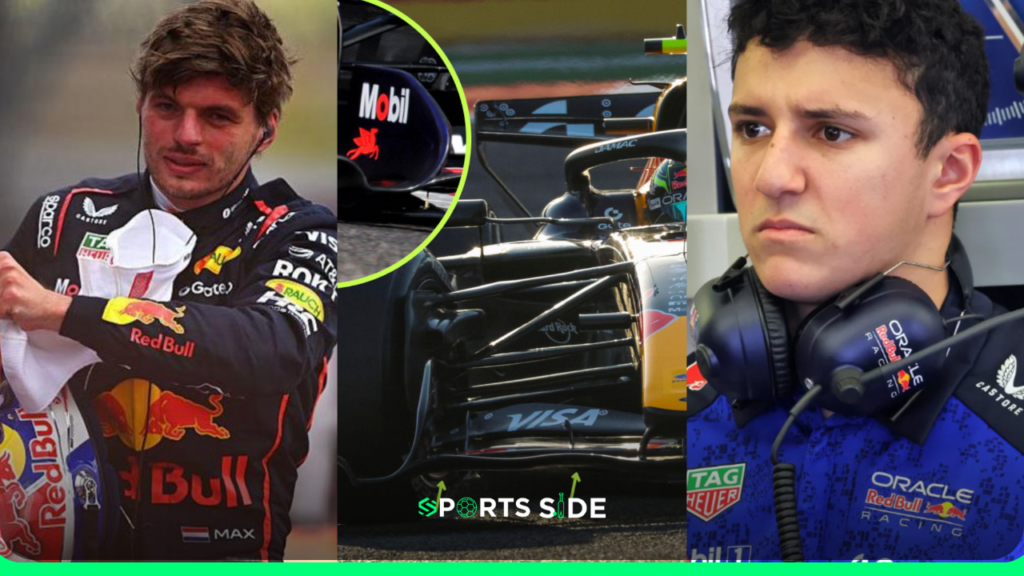
The 2026 Formula 1 season marks a regulatory reset, and for Red Bull Racing, the RB22 represents their first car built fully around the new 2026 F1 regulations and Ford power partnership. Red Bull dominated the previous regulation cycle, winning multiple Constructors’ and Drivers’ Championships. However, over the last two years, Red Bull failed to secure the Constructors’ title and struggled with car performance.
Now, with the 2026 regulations in place, can Red Bull regain the dominance of the previous era? With the first pre-season testing completed, are they on track to do so? How competitive is the new car, and can Isack Hadjar survive in the second Red Bull seat? This season preview covers it all.
Also Read
Red Bull 2025 Season Recap
Red Bull entered 2025 in a transitional phase following mid-season struggles in 2024, when they lost the Constructors’ title. The 2025 season also brought leadership changes, as Laurent Mekies replaced Christian Horner mid-season. The team’s driver lineup was inconsistent as well. Liam Lawson was initially announced as the second driver but was replaced by Yuki Tsunoda after just two races.
The RB21 failed to provide a consistent pace for much of the season, and both Verstappen and Tsunoda struggled to extract maximum performance from it. A mid-season improvement in car performance, combined with a dip in form from both McLaren drivers, allowed Verstappen to close the gap. In the end, he narrowly lost the Drivers’ Championship by just three points.
The team was unable to secure the Constructors’ title for the second consecutive year, with the Milton Keynes-based outfit finishing third, behind Ferrari and McLaren.
Red Bull 2026 Changes: Ford Partnership, Hadjar Promotion & Leadership Shift.
Heading into the 2026 season, the biggest development is the introduction of the new F1 regulations. The team’s driver lineup changes once again, as Isack Hadjar joins Verstappen following his impressive season with Racing Bulls, which earned him a promotion to the main team.
Alongside the driver change, there are notable management developments. Craig Skinner, Red Bull’s Chief Designer, departed the team after 20 years. His exit comes just weeks before the 2026 season begins, removing one of the team’s long-standing technical leaders.
Ford returns to Formula One after more than a 20-year hiatus, partnering with Red Bull on their Powertrains project following the end of the team’s long-standing partnership with Honda. The collaboration is set to continue at least until 2030.
Red Bull RB22 Technical Analysis Under 2026 Regulations
Red Bull’s RB22 has been developed under the new 2026 F1 regulations governing aerodynamics, chassis dimensions, and power units. The car is smaller and 30 kg lighter than its predecessor. It is built for a reduced-downforce philosophy, significantly altering airflow behavior, floor interaction, and wing usage compared to previous seasons.
The 2026 regulatory package introduces active aerodynamic systems, allowing wing flaps to adjust position strategically. Red Bull is running an aggressive open-diffuser concept, which extends airflow extraction between the rear tyres and the floor more efficiently than rivals.
The sidepods are narrower and sculpted to direct airflow with minimal drag while maintaining optimal cooling for the Ford power unit and electrical systems.
The 2026 powertrain regulations mandate a 50/50 split between internal combustion and electric power. Ford appears to be a strategic partner under these rules due to its expertise in battery technology, electric motors, control software, analytics, and internal combustion engine development.
Reports suggest Red Bull’s powertrain design pushes compression ratio engineering to the regulatory limits, exploiting ambient measurement allowances without breaching compliance. If validated under competitive conditions, this could provide a performance advantage.
Energy recovery and battery utilization will also be crucial. The new MGU-K and hybrid systems offer significant power deployment potential but introduce thermal load challenges, a key focus area for Red Bull’s engineering team.
Regarding the chassis, while detailed specifics on push-rod or pull-rod configurations remain limited, Red Bull is expected to have refined floor and suspension interactions to mitigate the more nervous handling characteristics associated with lower downforce regulations.
During Bahrain pre-season testing, the team ran different tyre compounds, fuel loads, and aerodynamic configurations. According to the combined data, Red Bull completed approximately 976 laps across testing. This places them mid-pack in total mileage, reflecting a balanced but not dominant testing programme relative to competitors.
The effectiveness of energy regeneration systems, thermal management, and hybrid deployment will be decisive in race conditions. Test mileage suggests Red Bull is exploring various configurations without fully revealing its true performance potential.
Driver Comparison and Dynamics Max Verstappen vs Isack Hadjar 2026
Verstappen delivered a strong 2025 campaign, scoring 421 points, securing eight wins and 15 podiums, and finishing runner-up in the Drivers’ Championship. It was Hadjar’s debut season, and he performed impressively for a rookie at Racing Bulls. He scored 51 points, claimed one podium, and outperformed both of his teammates.
Comparing both drivers in identical machinery during Bahrain pre-season testing, Verstappen’s best lap time was 1.15 seconds faster than Hadjar’s in Test 1 and 0.27 seconds faster in Test 2. The Dutchman also ranked near the top of the field in peak pace indicators.
Verstappen completed 219 more laps than Hadjar, indicating a larger test programme and greater mechanical data collection under Verstappen. This also reflects Red Bull’s prioritization of its lead driver for core development and long-run simulations.
In short-run pace, Verstappen’s peak time of 1:33.109 suggests the RB22’s potential ceiling in qualifying-style conditions. Meanwhile, Hadjar’s 1:34.260 is competitive but remains 1.15 seconds off the team’s peak, a significant margin on a low-downforce circuit like Bahrain.
In terms of driving styles, Verstappen is relentlessly fast across all phases of a race weekend. He excels at extracting performance within narrow operating windows and combines raw pace with strategic awareness. However, he can struggle with cars that do not suit his preferred handling characteristics.
Isack Hadjar’s driving style is smooth, with progressive throttle application and strong racecraft. The Frenchman has shown the ability to extract performance beyond the car’s baseline. He is less aggressive than Verstappen and, during early testing, struggled to match his teammate’s peak lap times.
Historically, Verstappen’s teammates have faced difficulties alongside him. The question now is whether Hadjar will follow the same path or whether he can adapt, evolve, and survive the demanding Red Bull second seat.