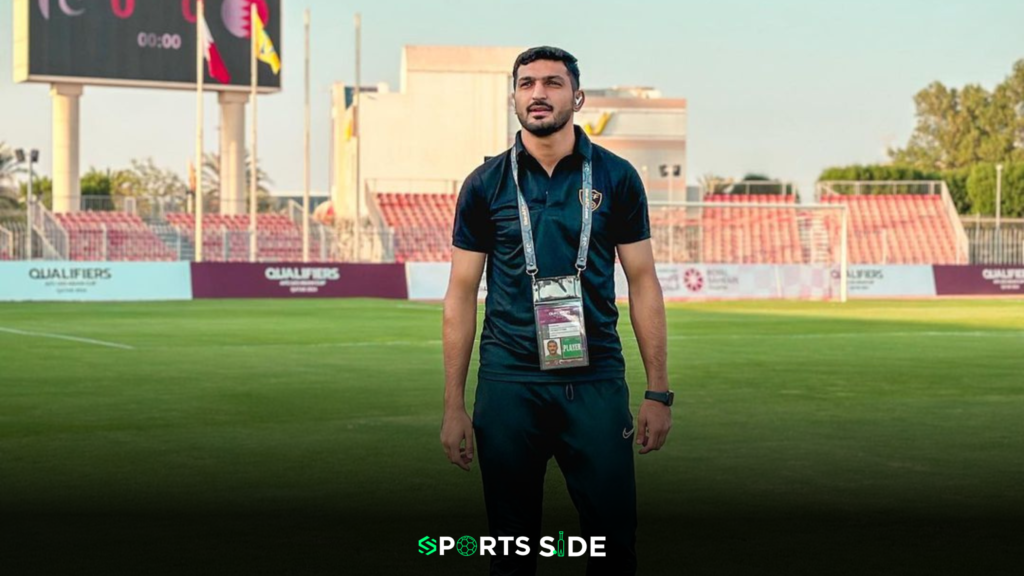
Abdullah Shah, a promising football talent from Pakistan, recently shared insights into his journey from local grounds to international arenas in a candid interview with The Sports Side. Being a late bloomer, Shah’s football journey only began in 2015, and since then, he has overcome challenges and setbacks to make his mark on the national and international stages.
The Early Years
Abdullah Shah describes himself as a local boy whose love for football ignited during his school years. During that time, he played football a lot and nurtured a strong desire to represent Pakistan, looking up to inspirational figures like Mohammad Easa and Kaleemullah. His breakthrough came in 2015 when he received a call-up for a U-14 camp.
He recalls, “I got my first call-up for a U-14 camp where Pakistan was going to play AFC qualifiers against Tajikistan. I tried out for the Islamabad team, and after being selected, I became the captain and played in the championship.”
“In 2015, my name was included for the national team camp. Out of 90 players, I was among the 18 who traveled to Tajikistan. That marked the beginning of my journey, and it was my first experience playing for Pakistan. It remains one of my happiest moments.”
Despite facing a setback with the ban that PFF recieved in 2015, Abdullah’s commitment to both education and football remained unwavering. He reflects, “During school time, I used to play football a lot and was passionate about playing for Pakistan. My parents had told me early on that I would have to continue my studies no matter what. Thus, when I ended up doing my bachelor’s, I still continued my football and was able to balance it out.”
Also Read: Harun Hamid: Pakistan Football’s Beacon – An Exclusive Glimpse into His Journey
Journey of Struggle and Resilience
Discussing his experiences, Abdullah Shah sheds light on the formidable challenges faced in the realm of football development in Pakistan.
“Football is a deprived game in Pakistan. The fan following started just now, but back then it did not exist. At the grassroots level, we had no one to guide us. I didn’t learn the game from an academy; there was no one to teach us how to even touch the ball.”
“In overseas countries, players learn basic football from a young age through academies and develop their skills systematically,” notes Abdullah Shah, underscoring the structured approach prevalent in international football development. However, he contrasts this with the situation in Pakistan, stating, “Here, we only learned how to play the game by observing others.”
Reflecting on his own journey, Abdullah acknowledges the significant hurdles he faced during his crucial developmental years: “From age 16 to 18, my progress was compromised due to the ban on Pakistan football.” Despite these challenges, he persevered, making a notable breakthrough by making his national debut at the age of 21 and simultaneously securing his first foreign contract in the Maldives.
“At 20, I earned my department contract at SSGC,” shares Abdullah, marking another milestone in his football career. However, he candidly admits, “My football development started late, which ideally should have commenced around the age of 16.” Despite having resources to focus on his diet and training, the delay in his developmental years, particularly during his peak, remains a poignant source of regret.
Balancing Football with Futsal
Abdullah Shah opens up about his multifaceted journey, stating, “If I talk about my futsal journey, currently, I have a professional contract with a futsal team called Team Eighteen. I have held a paid contract with them for the last 5 years, receiving scholarships for study, medical support, and training kits.”
From the onset of his sporting career, Shah engaged in both football and futsal, explaining, “I played both football and futsal from the start. Football has fewer events while futsal involves regular training.” Shah further elaborates, “In futsal, even though the format is short, playing as a defender taught me a lot. Like how to release yourself in a very small space. This skill helps you out a lot in football as well.”
Abdullah mentions that his football journey wasn’t limited to Popo FC; he also played for Mehran FC. He shares, “My Popo FC journey started when I was 13, joining the U-14 team. Before that, I represented Mehran Football Club for 10 years, a renowned club in Islamabad that has produced many stars. Alamgir, Haseeb, and many ex-players have played for Mehran FC. I spent 10 years with them. Later, I joined Popo FC for further development.”
Acknowledging the pivotal role of Popo FC in his growth, Shah notes, “They played a crucial part in my development. Haris bin Haroon is doing amazing work and deserves a lot of credit for his efforts. Popo FC supports young players by providing them with food and shelter.”
Shah emphasizes the significance of his time with Mehran FC, stating, “My foundational development was with Mehran FC, where I initiated my professional football journey. Later, for further development, I spent three years with Popo FC. As for futsal, I am still currently in contact. My department contract with SSGC was a significant achievement for me.”
Also Read: Imran Kayani: The British Asian Football Sensation Joining Pakistan’s FIFA Qualifier Journey
Resilience Amidst Setbacks: A Comeback from Injury
Abdullah Shah recounts a challenging period in his career marked by a significant injury, sharing, “Before COVID, I got an injury during a match where my ACL was damaged. I had to go through surgery and was out for the entire year of 2020.” By the end of that challenging year, AS made a triumphant return to the field, reflecting on the tough period of being sidelined from football.
Grateful for his recovery, he attributes his successful return to meticulous adherence to his doctor’s recommendations, including gym routines and physiotherapy sessions. He shares, “During my rehab, I started to do jogging and would later transition to running. I was able to return to the field in 10 months, but that rest time for me was very, very difficult.”
In response to queries about how players should handle such injuries, Shah offers valuable insights, stating, “Injuries are part and parcel of the game; ACL injuries happen quite often. The issue in Pakistan is when we get an injury, we don’t have awareness of whether to opt for surgery or if gym training could heal it.” He emphasizes the importance of seeking professional advice immediately after an injury, cautioning against the potential worsening of the condition if left undiagnosed.
Sharing a personal experience, he further narrates, “When I was going to play against Maldives, I got a hamstring injury. Before my trip, I got a slight stretch. While on the tour, I ended up getting another stretch during the warm-up to the extent that I couldn’t even walk.” Reflecting on this incident, he acknowledges the impact of not prioritizing the initial stretch, as it led to a three-month absence from the field, with his return occurring just 15 days before the SAF Cup.
Recounting the International Debut Against Nepal in 2022
Abdullah fondly reminisces about his international debut against Nepal in 2022, describing it as a “dream come true” for a boy who started playing from the school level to the national team. Reflecting on the significance of the moment, he shares, “It was a big achievement for me, for my family, for my coaches, my fans, and my supporters.”
Recalling the journey that led to his international debut, Shah mentions, “When I came back from Maldives, I got a call for the senior team. I was in the 36-man camp held in Lahore. Out of the 36, a 23-man squad went to Nepal.” In this historic match, 7-8 players, including Shah himself, Alamgir, Mamoon, Waleed, Zain ul Abideen, Qadir, and Abdullah Iqbal, were making their debut.
Playing away, without the support of local fans, added an extra layer of pressure, but Shah drew upon his experience from playing in Maldives to remain calm. He shares, “The debut was at an away match where we had no supporters, and everything was focused on the national team. So there was pressure, but because I had played in Maldives I was able to deal with the pressure by being calm and being friendly with the ball.”
Despite the pressure, Abdullah Shah’s debut was highly successful. Reflecting on his performance, he states, “The debut was very good, and my rating was, I think, 7.8 out of 10. That match gave me a lot of exposure, by dealing with the pressure, and I really enjoyed my debut.” Shah’s international debut not only marked a personal achievement but also served as a platform for future success, showcasing his ability to handle pressure and make a positive impact on the national stage.
Also Read: “Give Us Time, We’ll Show We’re the Best” Yousuf Butt’s Passionate Plea for Pakistani Football
Career Plans Beyond Maldives
“When I came back from Nepal, I had three to four offers to play in the Nepali first division leagues,” Abdullah shares, outlining the options available to him after leaving Maldives. However, he continues, “We had a Maldives camp for a month, then after that, we went to Mauritius, then to Bahrain, so a whole schedule was there for the whole year, thus I didn’t have time last year.”
Managing a busy schedule, and having additional commitments. He mentions, “Along with these games, last year I completed my bachelor’s as well. I will be applying for Masters as well, so wherever I get my admission, I will play there and take my career forward.”
It’s noteworthy that, after this interview, Abdullah made a move to join the Afghanistan club Abu Muslim, showcasing his adaptability and openness to exploring diverse opportunities for the progression of his football career. As he shares, “While I look forward to starting my master’s education in August, I want to utilize my current free time with a two-month stint at Abu Muslim Football Club. As it would be only a two-month stint with a good contract and University intakes start in August, everything falls into my set plans”.
This glimpse into his plans reflects the strategic approach Abdullah is taking to balance academics and football, demonstrating his commitment to continuous growth and development.
Football Infrastructure Challenges
Providing insights into the stark differences between the football infrastructures in Pakistan and Maldives, Abdullah sheds light on the challenges faced by local players.
“The football structure in both countries has vast differences. We don’t even have school-level leagues in Pakistan, which is a system where school-level leagues take place, and U14 teams are being formed, feeding players into the domestic system,”
Contrastingly, in Maldives, Shah highlights the comprehensive school league system, encompassing various age categories from U15 to U19, B Division, A Division, and Third Division. He describes these leagues as valuable opportunities for player development.
Shah expresses concern about the lack of international exposure for Pakistani players, stating, “In three months, our boys played no matches at the international level, and at the same time, the expectation from us is to play at a high level.”
He praises local players competing without proper infrastructure, support, facilities, or leagues. Despite facing challenges such as pending salaries, these players persevere and continue to represent the national team.
Further reflecting on the changes in the football setup since 2015, pointing out the absence of a structured league system. He recalls a time when departmental leagues provided a robust structure, allowing for a proper national team selection and ample match exposure.
Addressing the current situation, Shah highlights the importance of leagues for player development and expresses the need for at least a one-month league. He emphasizes the impact of playing regular matches on a player’s development.
Regarding Shayak Dost, who secured a promising transfer, he recognizes the importance of regular matches for a player’s growth. He stresses that a player’s development comes from the exposure gained during 90 minutes of play.
Abdullah Shah acknowledges the challenges faced by local players and urges understanding from fans, stating, “The fact that these guys are still performing without any facility is itself a big achievement.”
Team Selection and PFF Relations
The widely pondered question about Abdullah Shah’s absence from the team, prompting a thoughtful response from the player, as Shah states, “Every coach has his own mentality,” acknowledging the diverse approaches coaches bring to the game. He references Shezad Anwar’s coaching style, highlighting the strategic emphasis on starting the ball from the keeper and maintaining possession. Shah recognizes the coach’s different approach, style of play, and player preferences, indicating that these factors influence team selection.
Maintaining a positive and understanding stance, Abdullah Shah emphasizes, “I don’t have any reservations against anyone or ever asked why I wasn’t in the team.” He shows solidarity with his teammates, viewing them as brothers, and acknowledges their contributions. He takes pride in being appointed captain of the U23 team against Japan, a significant achievement in his football journey.
Looking toward the future of Pakistani football, Abdullah expresses optimism, saying, “Pakistan football just started now, so there will be more chances in the future.” He rationalizes that coaches have their own preferences, a sentiment he deems justified.
“What God has written for me, I will get that. I don’t have any issue with anyone, I just have to focus on my football and on my studies. I have no reservations with PFF or anyone.”
Football Factory and Grassroots Development
Football Factory, an initiative Shah is associated with as a brand ambassador, detailing the positive impact it has on grassroots football development in Pakistan.
“Faizan Sameer Malik joined Team Eighteen as the technical director,” Shah explains, highlighting the inception of Football Factory. He emphasizes Malik’s commitment to working for Pakistani football, specifically focusing on grassroots development.
Football Factory’s initiative includes the establishment of a football academy catering to various age groups. As Shah elaborates on the structured categories, ranging from toddlers and U8 to U12 and up to U19, concluding with a legacy team. This tiered approach ensures that children can engage with football at different stages of their development.
He underscores the significance of Football Factory’s efforts in nurturing young talents from an early age, stating, “They have made these categories so that kids can learn about football and development from a young age.” This approach aligns with the growing interest in football among parents who are now bringing their children to grounds for early exposure to the sport.
Sharing a personal reflection, he acknowledges the role Football Factory played in his journey, stating, “Football Factory has really helped me as well.” He contrasts his own experience, where there was no structured academy system during his formative years, with the current scenario where Football Factory is actively contributing to grassroots development.
Football Inspirations and Messages for Young Aspirants
In response to questions about his favorite players, Abdullah shares his admiration for Sergio Ramos, who not only influenced him with his playing style but also inspired his choice of jersey numbers—15 and 4. Ramos’s journey has resonated with Abdullah’s, making him a role model on the international stage.
Reflecting on his early days in Pakistan football, Shah expresses deep admiration for Kaleemullah, whom he considered a hero. Highlighting Kaleemullah’s remarkable journey from Chaman to playing in the USA without significant facilities, he found inspiration in his achievements. He remarks, “I took inspiration from him that if a boy from Chaman can achieve these feats, then why not me? What Kaleemullah did was a big achievement.”
In the context of a message for young footballers, Abdullah Shah extends his gratitude to his fans for their unwavering support. He acknowledges the significant role they played during both good and challenging times. He encourages aspiring footballers to pursue both football and education simultaneously, emphasizing the importance of education in shaping one’s character. Abdullah Shah concludes with a reassuring note, stating, “When God is with you, then you don’t fear anything else and can overcome everything.” This message encapsulates his perspective on holistic growth, encompassing both sporting and personal development.
Also Read: