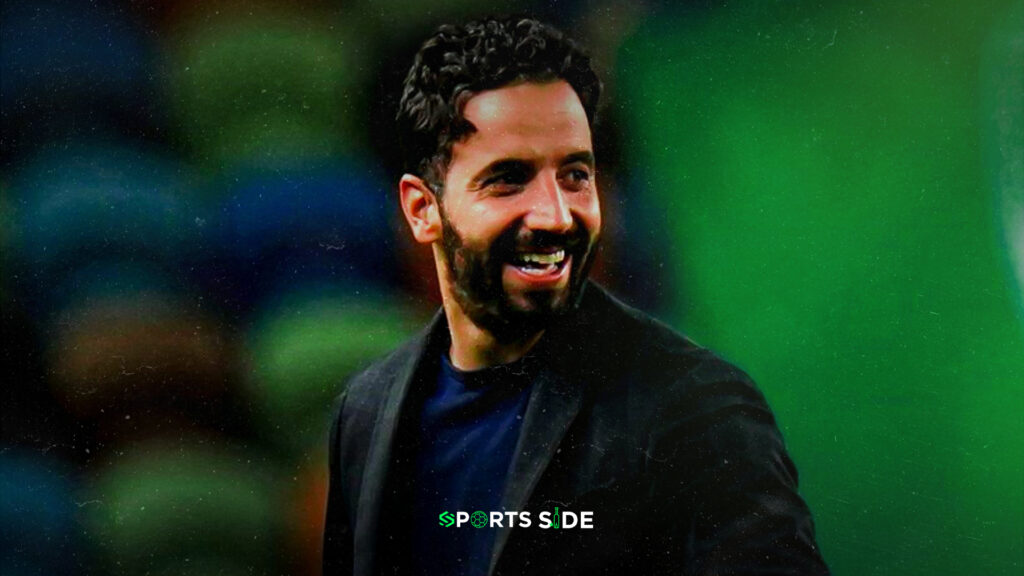
“I’ve got a problem,” Ruben Amorim replied when his friend Bruno Simao suggested arranging a trial game at the Portuguese club Belenenses so that the childhood friends could be reunited. Amorim and Simao, who had played football together since they were nine, had gone their separate ways after being released by their hometown club, Benfica, during their teenage years.
While Simao managed to secure a position at nearby Belenenses, midfielder Amorim was struggling to cope with being let go by the club he had supported as a boy growing up in Lisbon. “I said to Ruben, ‘Why don’t you come play with me again at Belenenses?'” Simao told BBC Sport. “I offered to speak with the coach to arrange a game where he could be evaluated.”
Amorim responded, “I cannot play; I broke my arm.” His football career seemed to be over before it began, but Simao was persistent. “Don’t worry,” he assured him. “I’m sure the coach will see you, and you’ll be able to stay with us.”
A trial game was eventually organized, and Amorim played despite his injury. “He was a center-back, and the coaches instructed all the players to ‘take care of him because of his arm,'” Simao recalled. “He completed the game and ended up staying with us at Belenenses. That was the start of his professional playing career.”
Ruben Filipe Marques Amorim’s journey is marked by a strong desire to succeed and a determination to overcome obstacles. These qualities are what the 39-year-old will bring to the Premier League after being named head coach of Manchester United.
“We keep in touch,” Simao said of the youngest full-time United head coach since Wilf McGuinness in 1969. “Ruben is the godfather to my eldest daughter, Carolina, who is now 18. Just yesterday, I messaged him about joining Manchester United. It’s a great opportunity for him. Although they are not currently in top form, it’s still a prestigious club, and for Ruben, it will be a wonderful experience.”
ALSO READ: What led to Gary Kristen’s Resignation? And How This will Impact Team?
‘Ruben cried after losing to Sporting’
Pedro Russiano recalls that Ruben Amorim was already a passionate player by the age of seven at Benfica. “When we lost to Sporting, I remember the whole team cried a lot, including Ruben,” says Russiano.
“We started playing football together 33 years ago at Benfica’s youth academy. Ruben was a very aggressive player who fought for every ball. I played on the left side of the midfield, and we developed great combinations. We learned a lot together as part of a good group that was solely focused on football.”
Located about 10 kilometers from Benfica’s Estádio da Luz, where Amorim would later find success despite an early rejection, lies the beautiful district of Belém along the banks of the River Tagus. It is here that Amorim made a name for himself as a player, earning a contract with Belenenses despite having a fractured arm.
Portuguese Cup Final
In 2007, Belenenses, then competing in the Primeira Liga, reached the Portuguese Cup final, where they faced Sporting at the Estádio Nacional, the same venue where Celtic celebrated their glorious 1967 European Cup victory over Inter Milan.
Inside the Belenenses club museum, a framed team picture from that day 17 years ago hangs on the wall. In the front row, second from the right, is a kneeling Amorim, flanked by Candido Costa, the former Braga winger, on his left, and Brazilian full-back Rodrigo Alvim on his right.
He was substituted after 71 minutes with the score still at 0-0. Sporting, which included former Manchester United winger Nani in their lineup, ultimately won the match 1-0.
“Despite the result, it was a great game,” said Patrick Morais de Carvalho, president of Belenenses. “Ruben was perhaps a step ahead of the others. He wasn’t an exceptional player, but he demonstrated an ability to assert himself on the field due to his intelligence in movement and his tactical understanding of the game from a very young age.”
In 2008, after making over 100 appearances in league and cup competitions, Amorim’s dream finally came true when the club that had once rejected him as a teenager came back to sign him.
“Ruben spent six years here, but we always knew that the club he truly loved was Benfica,” Morais de Carvalho added.
ALSO READ: