Overview
Whenever anyone brings up the state of Pakistan’s athletics, the conversation gets redirected to one name within about ten seconds. Arshad Nadeem. His gold medal in Paris was real, historic, and deserved, and I have no interest in taking anything away from it. But I want to be very clear about what that medal actually is.
It is a benchmark, a single data point showing what a Pakistani athlete can achieve when talent happens to be big enough to survive a broken system anyway. It was never proof that the system itself works. Use it as the bar, not as the story, and a completely different picture appears underneath it, one of shrinking contingents, vanishing athletes, dying disciplines, and a management culture that has not updated its thinking in twenty years.
This piece is not about Nadeem. It is about everyone else, and about the same handful of outdated minds who keep being allowed to run the sport into the ground.
The Benchmark Everyone Hides Behind
There is a very specific pattern I have watched play out since August 2024. Every time a journalist, a parent, or a former athlete raises a question about funding, facilities, or governance, the response from officials is some version of look what Arshad Nadeem achieved, as if one man’s Olympic record throw settles the argument. It does the opposite.
Analysts who actually follow the sport closely have pointed out that Nadeem’s success was the product of individual perseverance against the system, not because of any structure built to support it, and that without real reform even a medal of that magnitude will not produce lasting change underneath it.
A month after his win, as Pakistan’s team headed into the next Asian Athletics Championship cycle, observers were already noting that the broader infrastructure remained just as underfunded and neglected as before, with officials showing the same administrative apathy that predated the medal entirely. The bar was set in Paris. Almost nobody around Nadeem has cleared it since, and the reason is not a shortage of talent.
A Contingent Cut Down Before It Even Left
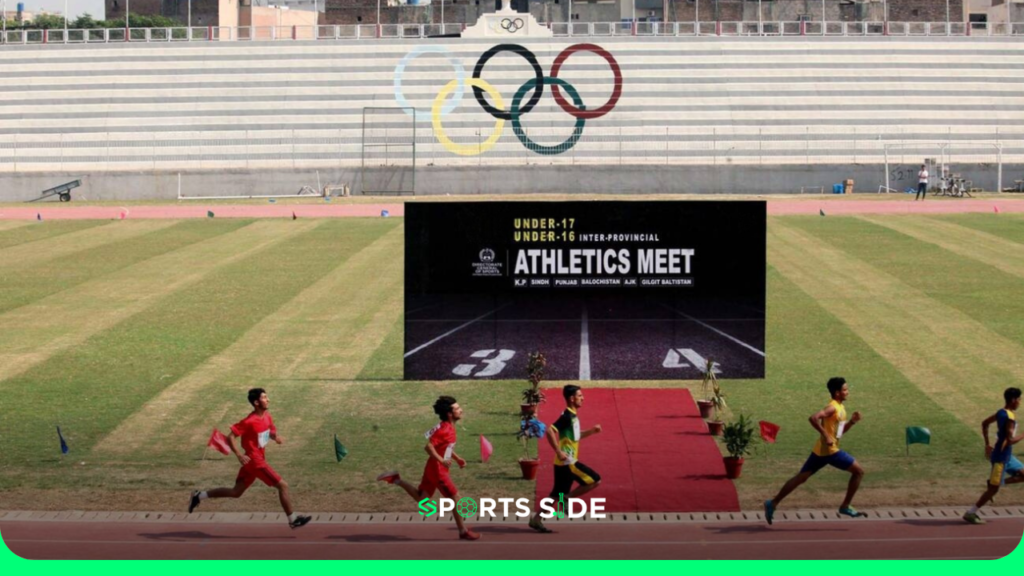
The clearest evidence of where athletics actually sits on this country’s list of priorities showed up just months ago, ahead of the 2026 Asian Games in Aichi-Nagoya. The Pakistan Sports Board, the very body responsible for funding athletes at international events, told federations to either shrink their squads or find their own money. Pakistan’s accredited contingent of 123 athletes was slashed toward 80, with further cuts still possible.
The Athletics Federation alone had its squad cut from fourteen to six, more than half its cleared athletes told, months out from the Games, that the funding they had been preparing around no longer existed. Picture that for a second. Young athletes spend a year building their bodies and their training calendars around a specific competition, only to be told weeks before departure that they now need to raise their own sponsorship or stay home.
This is not a one-off budget shortfall. It is the same script Pakistani athletes have been handed for years, and it guarantees that whatever talent exists never gets the repeated international exposure it needs to turn into results.
Outdated Methods, Confused Selection
Reporting from earlier this year painted an even bleaker picture of daily life inside the system. Athletes outside cricket describe training methods that have not moved with the times, limited access to modern sports science or recovery facilities, and selection processes that are opaque enough to fuel constant suspicion of favouritism.
The distance between the people who administer these federations and the athletes who actually compete under them has widened into open resentment, occasionally spilling into protest. None of this is confined to one event or one province. It is a pattern that repeats itself in sprinting, in the field events beyond javelin, in middle distance running, in every corner of a discipline that used to at least produce regional relevance.
And the people responsible for fixing it are, in large part, the very same office bearers who have held their posts through multiple election cycles without ever being held accountable for the decline happening on their watch.
The Safety Net That Quietly Disappeared
For decades, the one thing that kept Pakistani athletics semi-viable was the departmental sports system. Institutions like WAPDA, Pakistan Railways, the Army, national banks, and the airlines used to offer athletes a paying job that let them train without the constant fear of financial ruin.
That safety net has frayed badly, and it shows in how few young athletes are willing to gamble a career on a sport with no guaranteed income and no sponsor pipeline once departmental hiring shrinks. Sports quotas that once rewarded genuine merit have in many cases been replaced by recommendations and personal connections, which discourages exactly the kind of committed athlete the system needs to retain.
Parents who once encouraged a talented child toward track and field now steer them away from it entirely, worried about a future with no structure behind it, and that single shift in household decision making is quietly shrinking the national talent pool every single year.
Women Are Barely in the Room at All
If the picture is bad for male athletes, it is considerably worse for women, and especially for women outside Pakistan’s major cities. Athletes from remote and lower income districts describe being forced to quit before anyone even discovers their talent, simply because there is no funding, no equipment, and no one covering the cost of travel to a tournament that might have opened a door.
A women’s sports club in Larkana division training dozens of girls for free has had to turn away aspiring athletes because it cannot afford to send them to private competitions, a small but telling example of how thin the support structure gets the moment you move away from Islamabad or Lahore. Meanwhile, flagship projects like the multi-billion rupee academy carrying Nadeem’s name, or the newer multi-purpose complex being built in Faisalabad, raise an uncomfortable question that almost nobody in charge seems willing to answer honestly: what place, if any, do women athletes actually occupy in that vision.
Funding, consistent funding, is the single thing women athletes across the country say they need most, and it remains the thing they are least likely to receive.
When Athletes Simply Vanish
Perhaps the most damning symptom of all is one that rarely gets framed as a sporting story, even though it is entirely one. Pakistani athletes have started disappearing during international events, and not in small numbers.
Two athletes went missing during the 2025 FISU World University Games in Germany. Hockey players and a team physiotherapist sought asylum in Poland the year before that. Boxers vanished during the Commonwealth Games in Birmingham in 2022. These are not isolated personal decisions made in a vacuum.
They are what happens when athletes representing their country are, by multiple accounts, paid little or nothing at all, unable to afford basic training equipment despite wearing a national jersey, and staring at an economy at home that offers them a fraction of what a low-wage job abroad would.
A system healthy enough to retain its own competitors would not be leaking them at major tournaments. Ours is not healthy, and everyone in charge of it knows exactly why athletes keep walking away, they simply have no incentive to fix it.
Losing Legacy While Nobody Is Watching
Pakistan does not even hold on to the athletes who came before this generation. Abdul Rashid, the country’s national record holder in the sprint hurdles and a Beijing 2008 Olympian, passed away in December 2025 at the age of forty six, a full seventeen years after setting a mark that, remarkably, nobody has broken since.
Think about what that says. An entire generation has come and gone in this discipline without producing a single hurdler capable of beating a record set by a man who is now gone. There is no meaningful institutional memory being built, no mentorship pipeline connecting record holders of the past to the athletes trying to break their marks today.
Careers end, records stand untouched for decades, and the federation simply moves on to the next press release about a facility that has not been built yet.
The Old Guard Still Calling the Shots
None of this happens by accident. For roughly two decades, from 2004 until early 2024, the Pakistan Olympic Association was run by a retired three star general, a stretch during which the country did not win a single Olympic medal of any colour.
Also read:
- Spain Beat Argentina and Lionel Messi’s Dream to Win the FIFA World Cup
- Biggest Hits and Misses from the F1’s 2026 Belgian GP
- Spain Crush Messi’s Dream As Torres Breaks Hearts In Extra Time
Since his exit the story has simply shifted from one turf war to another, with the Olympic Association and the Pakistan Sports Board locked in open disputes over election transparency, constitutional amendments kept away from public view, and who actually holds authority over the national federations. Twenty three federations jointly accused the sports board of federal overreach, while the sports board accused the Olympic Association of holding elections without disclosing its own rulebook.
Critics have openly pointed out that many office bearers across these federations have occupied influential posts for years with essentially no accountability attached to their tenure. Political interference, not sporting expertise, continues to decide who runs these institutions, and until that changes, no amount of talent coming through the grassroots will be given a real chance to develop.
Verdict
Strip away the ceremonies, the cash prizes, and the repeated announcements, and the actual state of Pakistan athletics beyond one exceptional individual is a contingent that had to be cut in half before it even departed for the Asian Games, a training culture that athletes themselves describe as outdated and opaque, a departmental safety net that has quietly disappeared, women being pushed out of the sport before anyone discovers them, athletes vanishing at international events rather than coming home to nothing, and national records from a generation ago still standing because nobody has been developed well enough to challenge them.
Every one of these failures sits squarely on the desks of administrators who have run these institutions for years without consequence. This is not a talent problem. Pakistan clearly has the talent, Nadeem is proof of that on his own. It is a leadership problem, and it will not fix itself as long as the same outdated minds remain in charge of an entire generation’s future.
My Take on Pakistan’s Athletics
I have sat with this subject for a long time now, and the conclusion I keep coming back to is an uncomfortable one. Pakistan athletics is not struggling because the country lacks athletic talent. It is struggling because the people responsible for developing that talent have built careers out of holding on to their chairs rather than developing anyone underneath them.
Every metric that actually matters, contingent size, training quality, athlete retention, women’s participation, is worse than it should be for a country of this size and this much raw potential, and it has stayed that way through multiple election cycles because there has never been a real cost to failure for the people at the top.
Nadeem gave this country a benchmark and, unintentionally, a mirror. Everything the mirror shows underneath him is what happens when talent is left to fend for itself inside a system run by minds that have not changed their approach in two decades. Until the federations are handed to people who actually understand modern athlete development instead of protecting personal turf, one gold medal will keep being treated as the whole story instead of the exception it actually is.
Interesting to read:
Russell’s recovery and Aston Martin upgrade: 2026 F1 Hungarian GP Preview