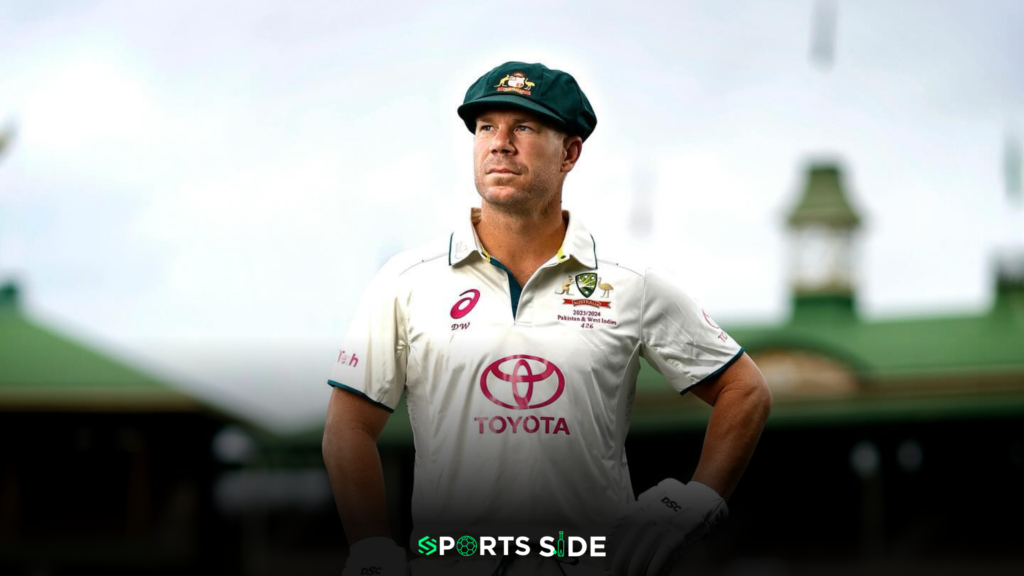
As cricket fans come to terms with the announcement of David Warner’s retirement from Test cricket after the third test against Pakistan, the focus naturally turns to the impending question: who will fill the shoes of the Australian experienced opener? The anticipation builds for Australia’s selectors, faced with a decision that will shape the team’s opening pair alongside Usman Khawaja in the upcoming Test series starting on January 17. With no first-class cricket in the ongoing period, the selection process becomes a little more complicated. Who should be David Warner’s replacement?
David Warner Bids Farewell To Test Cricket
As David Warner gracefully exits Test cricket, his role as a key asset for Australia and a top-class opener is indisputable. Throughout 110 Tests, Warner amassed 8,786 runs at an average of 45.05, reflecting his consistency at the crease. His batting repertoire includes 37 fifties and 26 centuries, with three double centuries.
On home turf, Warner’s record stands at 5,303 runs in 56 Tests at an average of 59.58, underlining his dominance in familiar conditions. His performances abroad, totaling 3,065 runs in 51 away Tests at an average of 31.59, and 283 runs in three neutral Tests at an average of 47.16.
Also Read:
Aamer Jamal Shines in Debut Test Series Against Australia: Record-Breaking Performance
What Experts Have To Say About This Matter?
The question of who should replace David Warner is a topic of debate among cricketing experts, and the discussions have been anything but straightforward. Warner himself expressed admiration for Matt Renshaw’s credentials when first asked about his potential successor in July. Later, during the Boxing Day Test, he endorsed Marcus Harris for the role.
Former Australian captain Ricky Ponting has thrown his weight behind Cameron Bancroft, while Michael Hussey has advocated for a specialist to take up the position, emphasizing the importance of rewarding Sheffield Shield form. Adding to the complexity, Coach, and selector Andrew McDonald suggested a potential reshuffling of the batting order, with Marnus Labuschagne being considered for an opening role and Cameron Green sliding into the middle order.
What Does The Sheffield Shield Have To Say?
The Sheffield Shield Puzzle
| Player | Innings | Runs | Average | 100s |
| Cameron Bancroft | 52 | 2384 | 50.72 | 10 |
| Matt Renshaw | 19 | 658 | 38.70 | 2 |
| Marcus Harris | 44 | 1545 | 37.68 | 5 |
| Sam Whiteman | 48 | 1606 | 34.91 | 4 |
| Daniel Hughes | 42 | 1253 | 33.86 | 1 |
Sheffield Shield, Australia’s premier first-class tournament, provides a nuanced perspective on the debate surrounding David Warner’s replacement. If statistics from January 2021 are the sole criteria, Cameron Bancroft emerges as the front-runner, boasting an average above 50 during this period and eclipsing contenders like Marcus Harris and Matt Renshaw in Shield centuries.
However, Bancroft’s history and lingering questions from 2018 cast a shadow, particularly considering the impact of his comments in 2021 on team dynamics. Examining career Shield numbers presents a more balanced picture, with Bancroft and Harris showcasing almost identical records.
Renshaw, while excelling at No. 5, faces scrutiny as an opener. Yet, the selectors’ tendency to consider Shield form has been inconsistent, as exemplified by the selections of Marsh, Labuschagne, and Head with modest Shield averages. When broader first-class cricket is factored in, the recent performances of Bancroft, Harris, and Renshaw in Australia A matches, Prime Minister’s XI games, and county cricket provide a more even comparison.
Another Major Factor: Australian Grounds
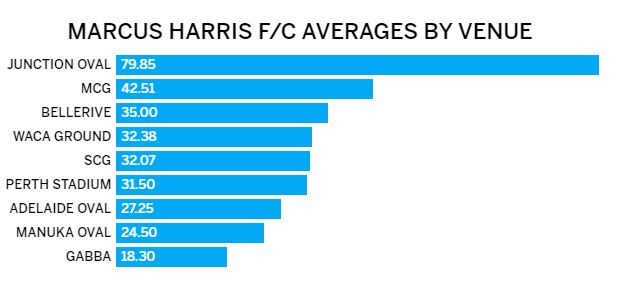
In the quest for David Warner’s successor, the Australian selectors move beyond surface-level statistics, meticulously analyzing player performances through Cricket Australia’s Athlete Management System. The playing field in first-class cricket isn’t uniform, especially in Australia, where the selectors consider the varying challenges posed by Test venues versus other grounds.
Marcus Harris, despite a solid overall first-class record, faces scrutiny for his standout performances at Melbourne’s Junction Oval, known for its flat pitches. While Harris excels at the MCG, his average takes a dip to 33.20 across Australia’s main Test venues.
Matt Renshaw encounters similar challenges, averaging 31.16 across these venues, even with a lone Test century at the SCG. Cameron Bancroft’s story unfolds differently; he shows improvement at Test venues, boasting an average of 40.32, particularly on faster, bouncier pitches.
David Warner’s Contenders Performance Outside Australia
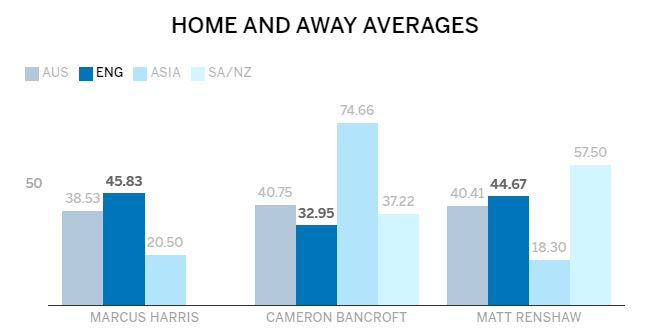
While Test records on home soil carry weight, the selectors face the challenge of finding a long-term opener for Australia, necessitating adaptability in overseas conditions. The historical criticism of David Warner’s performances in India and England adds complexity to this quest. With upcoming Test tours to New Zealand, Sri Lanka, West Indies, and a potential World Test Championship final in England, the selectors are tasked with choosing a contender with the ability to thrive in diverse conditions.
Although the selectors emphasize current form, the consideration of contenders’ performance abroad remains a constant topic of discussion, particularly with Usman Khawaja, aged 37, approaching the twilight of his career. Matt Renshaw’s overseas exposure strengthens his candidacy, with the majority of his 14 Test matches played abroad, including challenging conditions in India and Bangladesh. Despite a modest average of 20.80 in those eight overseas Tests as a 21-year-old, Renshaw has showcased promise in extreme conditions.
Cameron Bancroft’s spin-playing capabilities might be underestimated, highlighted by his impressive 150 for Australia A against India A in Chennai in 2015. While his record in South Africa faced overshadowing due to the sandpaper incident in 2018, Bancroft emerged as Australia’s leading run-scorer in challenging conditions.
Marcus Harris, on the other hand, boasts an impressive record in England, averaging 45.83, including Tests during the 2019 Ashes series. Despite being the first-choice reserve batter for the recent Ashes series, the selectors have expressed reservations about his performance against high-quality spin in subcontinental conditions based on his limited experience in Sri Lanka in 2022.
Also Read: