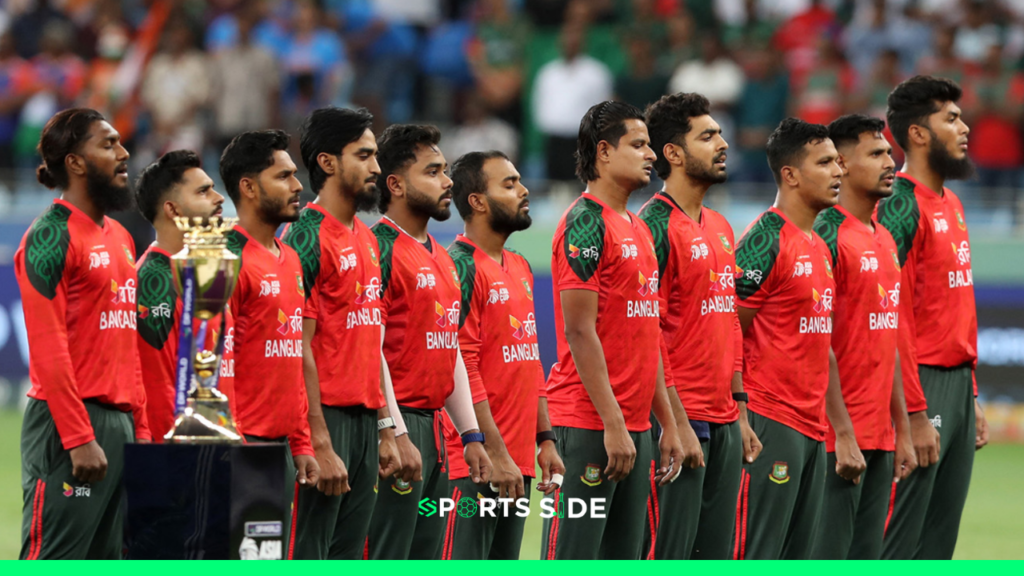
“Bangladesh should have participated in the T20 World Cup” was the verdict given by the committee set up by the Bangladesh government to investigate the reasons for Bangladesh’s boycott of the 2026 T20 World Cup. The committee was asked to determine:
- Why Bangladesh withdrew?
- The circumstances surrounding the decision.
- The roles of the government, Bangladesh Cricket Board (BCB) and other stakeholders.
- Administrative problems.
- The handling of the dispute with the ICC.
- The overall decision-making process.
Also Read
Background of events
On January 3, 2026, the Indian Premier League (IPL) team Kolkata Knight Riders released Bangladesh bowler Mustafiz Ur Rehman. Bangladesh reacted to this and asked the International Cricket Council (ICC) to move Bangladesh’s matches out of India to Sri Lanka, the co-host of the tournament, due to security concerns.
ICC declined the request and confirmed the matches would be in India. On January 24, ICC replaced Bangladesh with Scotland.
At the time, the interim government was in charge of the country’s affairs in Bangladesh and decided that the team would opt out of the tournament. In March, the new government ordered a probe into why the team missed the World Cup.
On September 15, 2026, the committee released its 22-page report and concluded that Bangladesh should have participated in the World Cup.
Major findings from the report
The most significant conclusion the report made was, as mentioned above, “Bangladesh should have participated in the T20 World Cup,” according to a committee member, Faisal Dastgir “(Bangladesh) should have gone and participated in the tournament.”.
The committee identified the youth and sports advisor, Arif Nazarul, and the interim government as responsible for Bangladesh missing out on the World Cup. As per the report, Nazarul was the person who made the final decision not to send the team to the event.
The Ministry (Youth and Sports) made the decision and communicated it to the Bangladesh Cricket Board (BCB), and the BCB did not object to it. The report said that such an important decision should not have been made by one person.
However, it is important to understand that Nazarul’s name was not mentioned in the report itself, but during the press conference about the report, it was made clear that it was about Nazarul.
The investigation revealed that players who were reportedly ready to travel to India had no objection to participating in the World Cup. Players Najamul Hossain Shanto, and Litton Das were interviewed for the investigation.
Shanto reportedly described Nazarul as the sole decision-maker, and he was not sure who else supported the decision. Litton Das also echoed similar sentiments as he described the decision “one-sided” and “preplanned”.
Players became spectators of the political conflict between Bangladesh and India.
What the report says about the decision-making process
The report also highlights the decision-making process that was followed during the making of this choice. The committee said Bangladesh lacked a sufficiently clear procedure for a crisis of this type. The committee highlighted:
- Weak coordination.
- Communication failures.
- Political involvement.
- Insufficient institutional independence.
- Lack of long-term planning.
- The need for better sports diplomacy.
In a nutshell, the committee treated this World Cup episode as an administrative failure.
Tamim Iqbal’s Important input regarding politics and Security excuse
Current BCB chairman Tamim Iqbal also gave some important evidence; his testimony was about the then administration prioritizing politics over the sport. He reportedly claimed that:
- Security concerns were being used as a justification for a decision that was fundamentally political.
- Political positioning toward India influenced the decision.
- The players’ World Cup opportunity was consequently affected.
What factors did the committee identify?
The report actually categorised the factors by impact level.
| Factor | Impact |
| Political tensions between Bangladesh and India | Very High |
| ICC refusal to move Bangladesh’s matches | Very High |
| Government intervention | Very High |
| BCB’s failure in negotiations | High |
| Breakdown in communication | Medium |
Limitations of report
Although the report is detailed, it has some limitations, as some of the important people’s points of view were not included, which was important to this case. Asif Nazrul and Aminul Islam Bulbul, the then BCB president, whom the committee attempted to contact but was not able to get a statement from.
The committee also did not contact the ICC to get their point of view. This is probably the biggest methodological limitation, as a central part of the dispute is concerned with:
- The ICC’s security assessment.
- Bangladesh’s request to move matches.
- The ICC’s negotiations with the BCB.
- Why the ICC refused to move the matches.
The committee’s assessment of the ICC was based on publicly available material rather than direct testimony from the governing body.
Asif Nazrul’s response
Nazrul did not outright reject the report; he acknowledged it and defended himself with the following points:
- National Dignity: He argued Bangladesh should not accept what he viewed as disrespect or unequal treatment from India.
- Safety: Nazrul said the decision was made for the safety of the players, journalists, and fans.
- Political stability: He said maintaining stability ahead of Bangladesh’s national election was another consideration.
He also questioned why the government was investigating this months later. He also stated the security concerns were completely valid and referred to ICC’s security report that highlighted security issues in India.
Nazrul also says that Indian authorities had not directly contacted Bangladesh about bringing the team to India for the tournament. His statements are critical as they provide a counterargument to this report.
What did the committee say about Mustafizur’s IPL incident?
It is also important to know what the committee’s opinion was on Mustafizur’s IPL incident, which started this saga. Committee member Faisal Dastagir reportedly argued that Mustafizur’s IPL situation was fundamentally separate from the World Cup.
In other words, the committee viewed the connection between Mustafizur’s IPL release and Bangladesh’s World Cup participation as inappropriate.
The committee’s recommendations to avoid such situations in the future
The committee also made some recommendations so that such situations could be avoided in the future. Some of the points from it are:
- Keep cricket separate from political disputes: Sport should not be used for political gains.
- Strengthen BCB independence: The Bangladesh Cricket Board should have greater independence in important cricket decisions.
- Improve crisis communication: There should be better communication between BCB and relevant stakeholders during crises situation.
- Protect players’ interests: Players’ interests should be protected and given preference.
- Create a national sports-diplomacy framework: Bangladesh should establish a clearer framework for handling situations where: sport + international relations + diplomacy + security