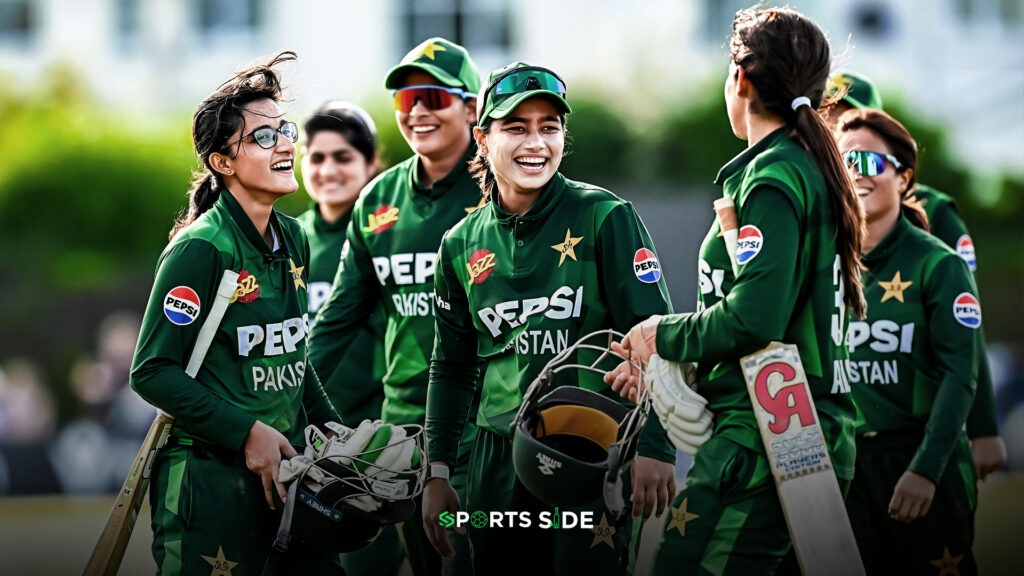
Muneeba Ali’s brilliant century in the third and final T20I powered Pakistan to an 8-wicket win at Clontarf Cricket Club, their first victory of the series. But it was Ireland who walked away with the series trophy, taking it 2-1.
In the third T20I, the hosts won the toss, chose to bat, and set a competitive target for Pakistan. Determined to avoid a whitewash, the Green Shirts came out firing in pursuit of 156 runs. Muneeba Ali launched the chase in style, smashing three consecutive fours off Orla Prendergast in the very first over.
Throughout the innings, Muneeba kept the scoring rate high with her aggressive stroke play. By the end of the powerplay, Pakistan had reached 55 for 2, with Muneeba unbeaten on 42 off just 25 balls, including 7 fours and a six. Aliya Riaz joined her in the seventh over, and together they built an unbroken partnership of 101 runs off 70 balls, guiding Pakistan to their highest-ever successful chase in Women’s T20Is.
Muneeba remained unbeaten on a magnificent 100 from 68 deliveries, laced with 14 fours and a six, while Aliya contributed a much-needed 39 not out off 27 balls after struggling in the first two games. Despite Pakistan’s batting heroics in the final match, Ireland had already secured the series by winning the first two encounters.
Series of two halves
This was almost like two series in one for Pakistan. In the first T20I, the team played much like they often do in the format, after choosing to bowl first, Pakistan’s strongest suit, their bowling, delivered by dismissing Ireland for 142 in the 20th over.
But in the chase, the familiar batting struggles returned. Chasing 143, both openers fell to poor strokes, and senior players like Aliya Riaz and Sidra Amin failed to lift the scoring rate. The rising required run rate piled on the pressure, proving too much for the lower and middle order. A late partnership between Natalia and Rameen took Pakistan to 131, but they still fell short by 12 runs.
In the second T20I, a different Pakistani batting side stepped onto the wicket after opting to bat first. Pakistan made two changes – 20-year-old Shawaal Zulfiqar came in for Gul Feroza, and right-arm leg-spinner Tuba Hasan replaced Diana Baig.
Both Shawaal and Muneeba started brilliantly, putting up 44/0 in the powerplay. After the strong start, the management shuffled the batting order, promoting aggressive batters like Eyman, Natalia, and Fatima ahead of senior players Sidra Amin and Aliya Riaz. It was a move few anticipated, but one that showed brave, much-needed intent for Pakistan, especially on high-scoring grounds.
Throughout the innings, the focus remained on sending in boundary-hitters, which meant Sidra Amin never got a chance to bat. At one stage, Pakistan were 131/3 at the end of the 15th over, with Fatima Sana on 10* (8) and Natalia on 27* (15). However, after Natalia’s dismissal, Aliya Riaz struggled to find the rope, scoring just 7 off 12 balls. An innings that once looked set for 180 eventually ended at 168.
In the bowling department, Pakistan kept things under control for most of the first 15 overs. Ireland were 111/3 at the end of the 15th, needing 58 off the last 5 overs — 4 of which were to be bowled by No. 1 spinner Sadia Iqbal and captain Fatima Sana, who had delivered a career-best spell in the first game. At that point, you would expect Pakistan to defend the total, but they faltered. Both Fatima and Sadia had an off day, and with 4 runs needed off the last ball, Sadia bowled a full toss that Maguire sent out of the park for six.
How often do you see Sadia Iqbal bowling a full toss, or Fatima Sana conceding heavily at the death? This was surely a bad day for both, but the approach our batters showed in the second T20I was a glimmer of hope for fans. This is the brand of cricket people want to see — the way the big 3–4 teams approach T20Is these days.
In the middle overs (7–15), Pakistan scored 87 runs — an area where they usually struggle to find boundaries. Young Eyman Fatima smashed 23 off 16 balls, Natalia Pervaiz added 31 off 17, and Fatima Sana chipped in with 23 off 16. It was the intent Pakistan has long been missing, and it’s exactly what fans have been waiting for.
In the first two matches, Pakistan’s real issue was going in with only five bowling options. In Match 1, Diana Baig had a rough day, conceding 35 runs in 3.4 overs, and in Match 2, Tuba Hasan gave away 36 runs in 3 overs while Natalia Pervaiz was taken for 15 runs in her single over.
In the third T20I, after experiencing one good day and one bad day in both batting and bowling, Pakistan finally went with a more balanced squad, opting for six bowling options. The second T20I likely made this decision easier for the management, as they had seen young batters take responsibility and play the full 20 overs without Sidra Amin. As a result, Sidra was left out for the final match, with Waheeda Akhtar coming in as the extra bowler.
After initially struggling to keep the Irish batters quiet, Pakistan’s bowlers gained control after the powerplay and restricted them to 155- not a daunting target on a batting-friendly pitch. Nashra Sandhu, Rameen Shamim, and Waheeda Akhtar delivered economical spells in the middle overs, putting Ireland behind in their push for a bigger total.
Batting
In the batting department, alongside Muneeba Ali’s stunning hundred in the third game, which made her the highest run-scorer for Pakistan with 132 runs at an average of 66 and a strike rate of 136.08, there were several other positives from the series.
Natalia Parvaiz, a right-handed power hitter who debuted for Pakistan in 2017, had previously managed just 87 runs in 17 T20I innings. Long regarded as a player with great potential but without any substantial performances, she finally got some runs under her belt in this series. She scored 69 runs in 3 matches at an average of 23 and a strike rate of 153.33 – the highest in the series among batters with at least 60 runs. In the first game, she made 29 off 23 balls, which at the time was her highest T20I score. She followed it up in the second game with a brilliant cameo of 31 off just 17 balls, which now stands as her career-best in the format.
Both youngsters, Shawaal Zulfiqar and Eyman Fatima, also produced one decent innings each. Shawaal scored 33 off 27 balls, while Eyman made 23 off 16 in the second T20I. Among other batters, Aliya Riaz, after struggling to get going in the first two games, batted brilliantly in the third, putting together a hundred-run partnership with Muneeba and finishing unbeaten on 39 off 27 balls. Captain Fatima Sana and Rameen Shamim also contributed in one game each, with Rameen scoring 27 off 20 in the first T20I and Fatima adding 23 off 16 in the second. Overall, apart from their middle-overs struggle in the first game, Pakistan’s batters did a decent job throughout the series.
Also read:
- How Private Investment Could Reshape the Big Bash League?
- Is Imran Khan Pakistan’s Greatest Test Cricketer Ever?
Fast Bowling
Although Fatima Sana produced her career-best spell in the opening match, Pakistan’s pace attack overall failed to meet expectations in the series. Diana Baig featured in the first game but struggled to adapt to the conditions. In the second match, Fatima Sana’s expensive spell in the death overs, conceding 28 runs in just two overs, proved costly. The third game saw a repeat of the issue, with the captain leaking 23 runs in her final two overs at the death.
Waheeda Akhtar did provide some control in the middle overs, picking up a wicket and delivering two tidy overs, but she too was expensive during the powerplay in the third T20I. Given the promising conditions for seamers in Ireland and considering the impressive performances both Fatima and Diana had delivered earlier this year in the ICC Women’s ODI World Cup Qualifiers in Pakistan, this was a disappointing return.
For both bowling coach Junaid Khan and captain Fatima Sana as the leader of the pace attack, this series will likely prompt some serious reflection. In many ways, the inconsistency of the fast bowlers may well have been the decisive factor in Pakistan missing out on a series win.
Spinners
In the spin department, Rameen Shamim emerged as one of Pakistan’s standout performers in the series. She bowled 11 overs, conceding 82 runs and claiming 5 wickets at an average of 16.4, with an economy rate of 7.45. Her versatility was evident in the way she operated across all phases of the innings — delivering 4 overs in the powerplay for 3 wickets at 8 runs per over, one over at the death, conceding 13 runs with a wicket, and 6 overs in the middle phase for 37 runs and a wicket at an economy of 6.16.
Rameen also made valuable contributions with the bat, scoring 35 runs at an average of 35 and an impressive strike rate of 152. Her all-around efforts provided crucial balance to the side and were one of the bright spots for Pakistan throughout the series.
Among the other spinners, Nashra Sandhu may have taken only one wicket in the series, but she was remarkably economical. Conceding just 67 runs in her 12 overs, she finished as Pakistan’s most economical bowler of the series with an economy rate of 5.58.
Sadia Iqbal, meanwhile, claimed 3 wickets at an average of 27.66 and an economy rate of 6.91. While these numbers are respectable, they fell short of the high standards expected from the world’s No.1-ranked T20I bowler. She will likely be disappointed with her inability to defend 4 runs off the final ball — a situation in which her class and experience are usually decisive.
Tuba Hasan, featuring in two matches, struggled for rhythm in her first outing, conceding 36 runs in 3 overs without a wicket. However, she showed improvement in the third T20I, ending the series with figures of 0 for 52 from 5 overs. While wicketless, her comeback in the final game suggested signs of adjustment.
Pakistan’s tour of Ireland ended 2–1 in the hosts’ favor, but it was a series Pakistan could have won. Missed chances — failing to chase 143 in the first T20I and not defending 58 off the last five overs in the second — proved decisive. In the opener, poor shot selection from Gul Feroza and a slow, pressure-building stand from senior players Sidra Amin and Aliya Riaz stalled the chase, with just 20 runs scored in five overs after the powerplay. Captaincy decisions also came under the spotlight; in the second T20I, Fatima Sana’s choice of bowling order at the death arguably left Sadia Iqbal with too little margin to defend. These moments, rather than a lack of Skills, ultimately cost Pakistan the series.
Despite the defeat, Pakistan showed glimpses of a bold, attacking brand of cricket, particularly in the second and third matches. The challenge now is to turn these flashes into consistent performances against stronger opposition
Read More: