Over the years, Pakistan cricket has been a formidable factory for producing some top-class batters in limited-overs cricket. Apart from gifting those who were consistently terrific—like Javed Miandad, Mohammad Yousuf, and Misbah-ul-Haq—Pakistan cricket has also made sure that the cricket audience in the country never feels deprived of being spectators of those impactful players who can change the course of the game. Pakistan’s audience has remained blessed to witness the likes of Inzamam, Saeed Anwar, Razzaq, and—to some extent—Shahid Afridi, who wasn’t only ahead of their time but also conducted their careers by combining a great average with a wonderful strike rate.
Over the period, there was a discernible slump in producing these lots of impactful batters. Particularly in the last decade, the majority of Pakistani fans—including myself—have been vocal about Pakistan’s stark decline in this department. There were articles by cricket pundits and data analysts dissecting how Pakistan had struggled to unearth such elite talents. Truth be told, this was an undeniably valid argument—it genuinely felt like a pressing issue to me.
For years, I had this disappointment lingering in my mind that Pakistan cricket hasn’t produced players of the caliber of likes of Klaasen, Sharma, Miller, Buttler, or Pandya for quite some time now—players who can win matches on their own, who could compel us to find the stark light of love for this sport, uncompromised by a fearful “Mr. Nice” act.
I had convinced myself that this conclusion was a genuine reason why we were not doing well in white-ball cricket—unable to achieve distant, towering, impossible, unimaginable feats. I thought we were carrying illusions—like a carrot for a donkey.
I still think I was quite right, based on my creative brainpower and my judgments, however.
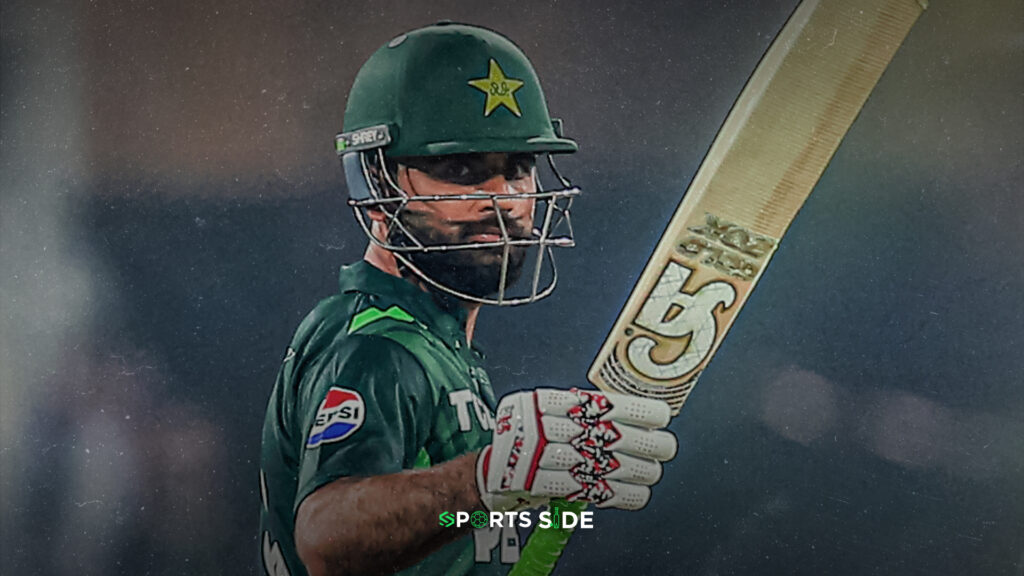
The fool was I to not consider Fakhar Zaman of Mardan, though. He has been, as Churchill said of Russia, “a riddle wrapped in a mystery inside an enigma.”
Fakhar might not belong to the same elite class as these stalwarts—he might not be as consistent as some of his contemporaries, and he might not enjoy the same hype as some of the big names—but he does have enough credentials to claim that his name needs to be taken in that list, being the sole Pakistani to own the impact chart.
Is the ‘Impact Player’ tag fitting for Fakhar?
A simple question—if the Pakistani team is batting and facing a massive target, who is the one player you’d trust to keep their chances alive? The one who, as long as he’s at the crease, makes you believe the game is still within reach? The one who would do everything in his power to snatch victory from the opposition? There may be plenty of arguments, but my finger points only toward Fakhar—that’s when you truly realize how invaluable he is.
He is, at once, a man whose role is so unique that just about no one else in Pakistan can replicate it—the only power-hitting, firestarter opener in this squad, capable of the kind of big, skyscraper batting. When he finds himself in the zone, few other batsmen in world cricket look as capable of sending every delivery over the heads of any fielders placed between long-on and midwicket—a man capable of conjuring a six out of nothing. He has this gravitational force that he now comfortably channels, one that demands you stay pinned down for every single ball he faces.
Like that inning in the Champions Trophy final in 2017—India vs. Pakistan, the final of an ICC event, with hundreds of millions watching every ball—and he walks in like a club cricketer who has just raced there from work, ready to have some fun. It might be a guy playing only his fourth game, but it looks like someone who has been doing this for ten years, utterly unfazed by failure. Staring the very concept of pressure right in the eye, he makes a mockery of it—killing it with his unparalleled tranquility.
Imagine how extraordinary your very first tournament must be when someone as great as Virat Kohli acknowledges your brilliance in style after witnessing you for the first time from the receiving end. These were the exact words from India’s finest:
“When guys like Zaman get going, he plays unorthodox shots, they’re really difficult to stop. Eighty percent of his shots were high risk and they were all coming off. You can only do so much as a bowler and a captain when that is happening. Sometimes you’ve to sit and say the guy is good enough on the day to tackle everything. The controllables become very little when people are doing well like that..”
Or take that unforgettable innings of 126 in a must-win game against New Zealand in the 2023 World Cup—chasing a mammoth 400. Pakistan was written off, deemed to have no business even contesting the match—until the entire crowd at Chinnaswamy bore witness to the sweet sound of Fakhar’s bat. A tock—unthreatening and benign as a table tennis pong. A sound that represents modern batting in green shirts—a sound of a leftie swallowing everything in his path to achieve the impossible. A sound of his deepest genius, his true endowment—the poetry of his very being.
There haven’t been just a few instances you could count on your fingertips where Fakhar has flipped the game’s switch seriously—200+ in Zimbabwe, 194 in South Africa, 134 in England, and many more milestones for a man who doesn’t care about personal records. There’s not enough wattage in the world to measure the electricity of his every single inning.
Read more: Williamson, Warner, Chapman among big star signings in HBL PSL 2025 Draft
How Fakhar does what he does best!
Fakhar’s methods are rusting and unorthodox. A mere glance at his grip tells the story—his back foot often strays outside the leg stump. He is one of the rare batsmen in top-level international cricket who lacks a trigger movement, reacting only after the ball has left the bowler’s hand. He stays beside the line of the ball, relying purely on the sharp coordination of hand and eye. It’s a technique that thrives on instinct, one that likely wouldn’t respond well to excessive tinkering.
Sometimes, when you look at Fakhar Zaman, you wonder what it takes to succeed with such an unorthodox technique. But technique itself becomes merely a liaison between ambition and execution when it is fueled by unwavering self-belief. When he finds his zone, something clicks on a biological level. The signals from his mind to his body—controlling the bat swing, fine-tuning hand speed, sharpening his vision—all align in perfect harmony.
Fakhar is the strong square of the pitch—he likes width and throws his hands at anything short or full, wide of the stumps. He also has a reasonably good pick-up shot when the ball drifts onto his legs.
The self-belief, however, is something truly special about Fakhar. He’s been able to summon deep mental reserves even when he’s not at the top of his game. He has planted commands right into his skull—that he’s going to play for the star on his shirt most humbly.
Even being generous, it can easily be said that Pakistan has found an opener in the form of Fakhar in the post-Sehwagian age—one who neither worries nor gets tied down by what has passed but only believes in what he can do with what lies ahead. He’s an indomitable character, with a heart as cold and hard as a taxman’s—not one to be moved by the moment.
It shouldn’t surprise or raise eyebrows that, statistically, Fakhar is Pakistan’s best ODI opener since Saeed Anwar.
What does it mean to be Fakhar?
Fakhar means “Pride” in Urdu. Pakistani fans call him “Fakhar-e-Pakistan.” His PSL franchise hails him as “Fakhar-e-Qalandars.” The English-speaking audience often hesitates to pronounce his name. But whether you call him “Fakhar-e-Mardan,” “Fakhar-e-Talagang,” “Fakhar-e-Navy,” or simply “Fouji,” the essence remains the same—at his core, he is the “Fakhar of cricket,” a name who was cherished in countless ways.
There are records, and then there are peak records—and Fakhar owns them all, especially in ODIs. But the value of a man cannot be measured in just runs and stats; he simply needs to be elite. His presence carries a weight that defies measurement, an aura that demands respect at every moment on the pitch.
To be Fakhar is to be more than a player—it’s to sacrifice for your team, to play with a passion that moves the stars themselves, to hold onto honesty as fiercely as to victory. You need to be an underdog, a miracle worker, a thwarter of expectations happily stagnating in a zone.
You just cannot replace these kinds of players. You simply cannot. When Fakhar is gone, his sudden departure will feel like a lightning bolt to the heart—but he will be remembered as someone like Saeed Anwar. The shouts of “Fakhar chalta hai to Pakistan palta hai” will not just be a mere myth.
The next two to three years could be the last phase—for Fakhar’s career. There is still something lacking. Apart from Fakhar being in cruise control in his pursuit of establishing a legacy, there remains a desire to go beyond, to untrap himself, to enjoy the game free of that subtle, underlying tension—the fear of not winning a trophy.
With the kind of form he possesses and the role he’s assigned, Pakistan can only hope he gets even better from here.
Read more: