This paper examines Pakistan’s ongoing struggles in T20 cricket, particularly the lack of boundary-hitting capability and an inability to maintain a high run rate. Using two innovative metrics—Mean Consecutive Dots/Singles and Average Balls Between Two Boundaries—we evaluate the performance of batters who have played at least 20 T20 innings in Pakistan since 2015. Our findings categorize batters into three groups: Impactful Batters, Movers of the Scoreboard, and Scoreboard Pressure Creators, and propose an optimal strategy for team selection.
Introduction
The evolution of T20 cricket has drastically shifted batting dynamics, emphasizing boundary-hitting and aggressive intent. Pakistan’s inability to meet these demands was glaringly evident in their recent loss to Australia, where they failed to chase a modest target of 143 and went boundary-less for the first nine overs—a world record. This paper aims to address the shortcomings in Pakistan’s T20 strategy by providing a data-driven framework for selecting an ideal batting lineup.
Methodology
We analyzed the ball-by-ball performance data of batters in T20 matches played in Pakistan since 2015, focusing on two key metrics:
- Mean Consecutive Dots/Singles – This measures how often a batter plays consecutive dot or single-run balls. In T20 cricket, scoring at a run-a-ball is considered suboptimal.
- Average Balls Between Two Boundaries – This metric calculates the average number of balls a batter faces between hitting boundaries, offering insights into their ability to maintain momentum.
Rationale for Choosing These Metrics
Here are few reasons for that:
T20 cricket dynamics: In T20s, where resources (balls and wickets) are highly constrained, every delivery is crucial. Scoring a single run off a delivery, while seemingly positive in longer formats like ODIs or Tests, is often seen as suboptimal in T20s. This is because singles don’t significantly shift the scoring rate in a format where high strike rates are necessary to achieve competitive totals.
Bowler’s perspective: A bowler who restricts a batter to singles or dot balls creates pressure on the batting side, limiting their ability to accumulate quick runs. This can lead to batters taking higher risks, potentially resulting in false shots or dismissals.
Scoring pressure and efficiency: To assess a batter’s ability to manage this pressure, examining their average or mean length of consecutive dot balls and singles provides insights into their scoring efficiency and adaptability. Shorter streaks of consecutive dots and singles indicate a batter’s ability to break free of scoring droughts and maintain momentum.
Here is an illustrative example of what are we discussing:
A batter who faces six consecutive dot balls or takes singles (Mean Dots/Singles = 6) before hitting a boundary (Avg. Balls Between Boundaries = 7) shows inefficiency in maintaining momentum. Conversely, a player with Mean Dots/Singles = 2 and Avg. Balls Between Boundaries = 4 reflects higher adaptability and scoring intent.
Batters with at least 20 innings on Pakistani soil were considered. We categorized them based on their performance across these metrics.
Results and Discussion
- Impactful Batters
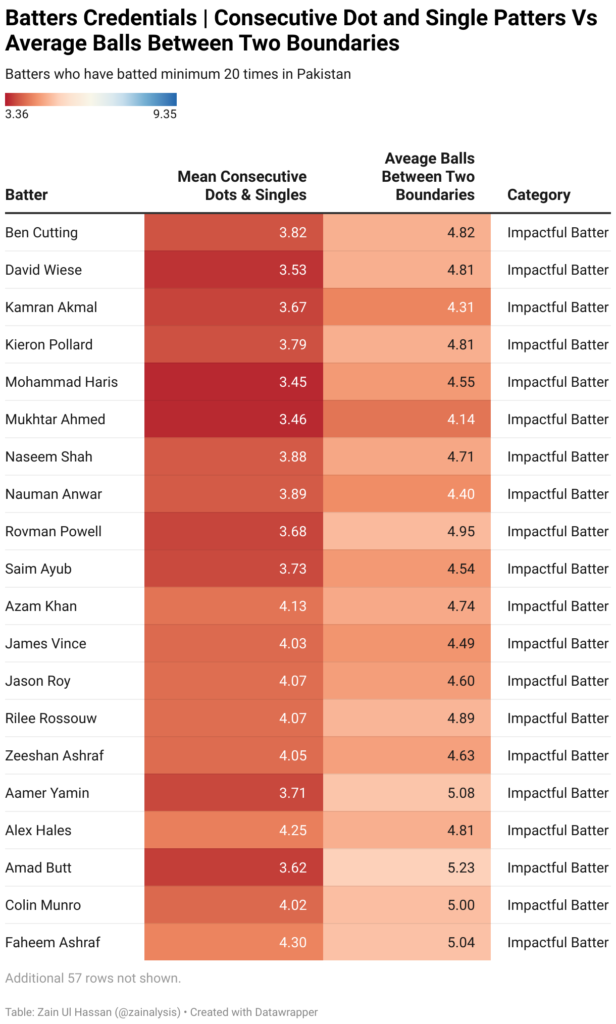
These players minimize consecutive dots and singles while maintaining a high boundary frequency. Their performances reflect an aggressive intent, essential for modern T20 cricket. - Notable Players:
- Mohammad Haris (Mean Dots/Singles: 3.45, Avg. Balls Between Boundaries: 4.55)
- Saim Ayub (3.73, 4.54)
- Azam Khan (4.13, 4.74)
- Fakhar Zaman (4.56, 5.39)
- Asif Ali (4.31, 5.50)
- Zeeshan Ashraf (4.05,4.63)
- Faheem Ashraf (4.30, 5.04)
- Haider Ali (4.17, 5.33)
- Qasim Akram (3.44, 5.14)
These batters should form the core of Pakistan’s lineup, providing the momentum required to post or chase high totals.
- Movers of the Scoreboard
These batters strike a balance between stability and aggression but take longer to find boundaries. While valuable in anchoring an innings, their presence should be limited to one in the XI to avoid slowing the run rate. Shadab Khan plays mere 3.71 consecutively for 0 or 1 or both. So, he can be categorized in Impactful batters for some good reasons.
While “Impactful Batters” prioritize high boundary frequency and minimal dot-ball pressure, it is important to acknowledge that such players may face challenges against tighter bowling or on difficult surfaces where boundaries are harder to come by. This is where the role of “Movers of the Scoreboard” becomes critical, as their ability to rotate strike and maintain the scoreboard under challenging conditions can provide stability and prevent collapses.
Shadab Khan exemplifies this balance effectively. With a Mean Dots/Singles of 3.71 and Avg. Balls Between Boundaries of 5.53, he bridges the gap between aggression and stability. His numbers reflect not only a capacity to find boundaries but also a reliable knack for rotating the strike. This makes him adaptable across varied match scenarios—whether on flat tracks favoring big hitting or in low-scoring games where strike rotation becomes paramount.
For instance, in situations where aggressive batters like Asif Ali or Fakhar Zaman may struggle to clear the boundary due to tight bowling, Shadab’s ability to avoid prolonged scoring droughts can hold the innings together. His skill set allows him to build pressure on the opposition by ensuring consistent scoring, setting a platform for more aggressive batters to thrive at the other end.
Thus, Shadab’s inclusion highlights the strategic importance of having at least one batter capable of maintaining momentum through strike rotation, ensuring the lineup remains balanced and less reliant on boundary-hitting alone.
- Notable Players:
- Babar Azam (4.03, 5.79)Shadab Khan (3.71, 5.53)Khushdil Shah (4.57, 5.71)
- Iftikhar Ahmed (4.76, 5.95)
While Babar Azam’s contributions include 11 T20 centuries and he bats better than the likes of widely proclaimed hitters Khushhdil & Iftikhar with batter length of consecutive dots/singles and better average balls between two boundaries.
- Scoreboard Pressure Creators
These players exhibit high Mean Dots/Singles and long intervals between boundaries, contributing to scoreboard pressure on the team. Such batters should be excluded from the playing XI in T20 cricket. - Notable Players:
- Mohammad Rizwan (4.16, 6.53)Abdullah Shafique (4.21, 6.33)Haris Sohail (5.22, 7.29)Agha Salman (6.24, 6.16)Irfan Khan Niazi (4.54, 6.07)
- Sahihbzada Farhan (4.47, 6.39)
While players like Rizwan excel in other formats, their conservative approach is less suited for the fast-paced demands of T20 cricket.
Implications for Team Selection
The findings suggest that Pakistan’s T20 batting lineup should prioritize Impactful Batters to maximize run-scoring opportunities. Movers of the Scoreboard can provide stability but must not dominate the playing XI. Scoreboard Pressure Creators, despite their technical prowess, should not feature in the squad to prevent stagnation during crucial phases of the game.
Conclusion
T20 cricket is a game of calculated risks, where aggression often trumps conservatism. Pakistan’s current selection strategy must evolve to reflect this reality. By prioritizing Impactful Batters like Mohammad Haris, Saim Ayub, Azam Khan, and Fakhar Zaman, and limiting the inclusion of traditional anchors, Pakistan can address its boundary-hitting deficiencies and compete with the best in the format.
Future Research
This study opens avenues for further research on the situational impact of batting performances, including how players adapt under varying conditions and match scenarios. A comparative analysis with successful T20 teams like England and India could provide additional insights for Pakistan’s cricketing framework.