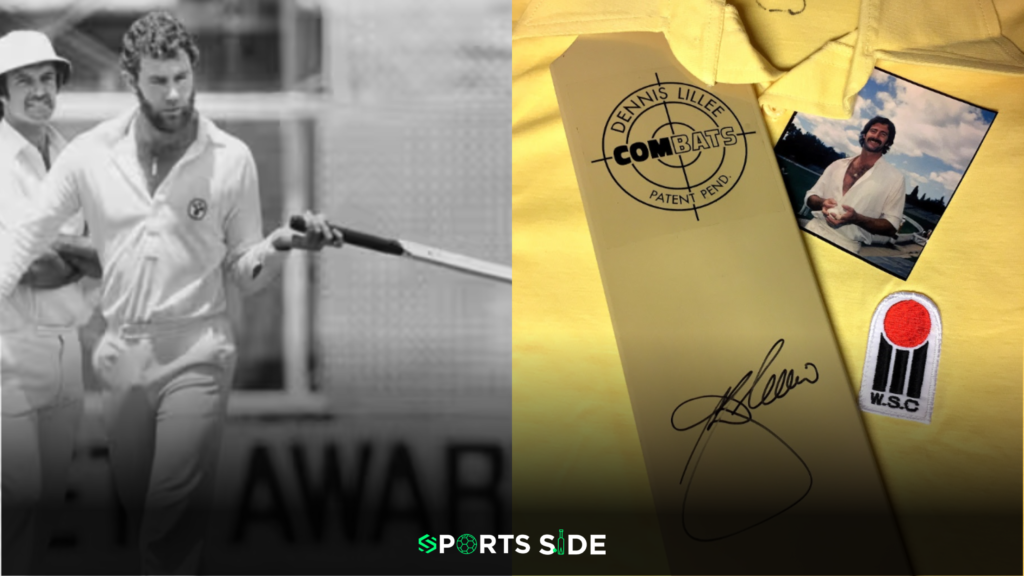
In the annals of cricket history, there are moments that defy the ordinary. One such incident unfurled during England’s tour to Australia in the winter of 1979-80 when Dennis Lillee, FOT, walked onto the pitch wielding an unconventional weapon—the aluminum bat named ComBat
Lillee had already used the bat in a Test match 12 days earlier against the West Indies at Brisbane. However, the real show was in Perth during the Ashes series. Lillee was batting on 11, and the Australian team had ended the day at 232 for 8. What followed was a series of events that left spectators and players astounded.
Marketing Gimmick:
Inspired by the substitution of wood with metal in baseball bats, the aluminum cricket bat was the brainchild of Graham Monaghan, a former club cricketer and a close friend of Dennis Lillee. The target market for this inexpensive alternative was recreational cricket, schools, and developing countries. However, in December 1979, Lillee, who was also a business partner with Monaghan, decided to debut this unorthodox piece of gear during a Test against England at Perth. This made it pretty clear that this unconventional choice was more than just a personal preference; it was merely a marketing stunt. In the middle of a Test match between. Between England and Australia, the fiercest of rivals.
Lillee had already used the bat in a Test match 12 days earlier against the West Indies at Brisbane. However, the real show was in Perth during the Ashes series. Lillee was batting on 11, and the Australian team had ended the day at 232 for 8. What followed was a series of events that left spectators and players astounded.
Aluminum bat – Metal clashing leather:
Lillee’s captain, Chappel, had taken notice of his unconventional choice of weaponry on the morning of Day 2. However, he couldn’t care less about what type of bat his number 9 batter walks out on a crease with, especially when he happens to be your fiercest bowler. One would think it’s just another one of those cunning Dennis classics to flip off the opposition.
When a charged-up Botham, running in to complete his fifer and looking to clear up the tail is taken aback by the metal clung of a solid block by his contemporary bowler standing on the crease; Chappel had nothing to complain about. However, when you see a drive that has four written all over it, and crawl right back at the bowler, you’d think it’s time to intervene.
Also Read: Pakistan sleepwalking to World Cup Defeat
Chappel thought this marketing stunt was causing the team valuable runs. Ultimately, the play had to be stopped as the 12th man Hogg was sent by the skipper to ask Dennis to bring out his willow.
However, you don’t really associate being submissive to Lilly. Knowing this the wicketkeeper Rod Marsh, never one to be just a mere observer was heard quipping “You are not going to let the umpires tell you what to do, are you?”. That was it for Dennis to become more adamant about persisting with his metal sword. Leaving many surprised, Dennis was back on crease wielding his ComBat.
There was quibble from the other side as well now, with Mike Brearly pointing out how the metal was damaging the new kookaburra to the umpires. Fearing for his head being tonked, Hogg refused to go back on the ground as a delegate for his captain. Consequently, Chappel himself had to trickle down the pavilion and carry Dennis’s bat for him.

Watch your head, Chappel!
Seeing his captain himself coming down on the field to reprimand him, he knew he had to oblige. Not so chappy Lille sent his beloved bat flying across Chappel’s head, giving him an almost haircut, and finally agreeing to bat with the good old wooden bat. Maintaining composure, Chappell passed the willow to his fast bowler and strolled to the dressing room, retrieving the contentious piece of metal along the way.
No one really benefitted from this incident except, of course, Chappel himself. He now had a seething Lille in his armoury; a raging bull who had seen red colour, with no metador in sight. Running through the top order with ease, sending the openers with ducks, and making life a living hell for Brearly. An exciting finish saw the historic game end, with England being bowled out just 20 minutes away from saving the test.

This incident had a profound impact. Sales of the aluminum bat soared, and it garnered considerable attention for a short period. However, cricket’s governing bodies soon took note and swiftly acted. Rules were promptly instituted, explicitly mandating that bats must be made of wood.
Read More: